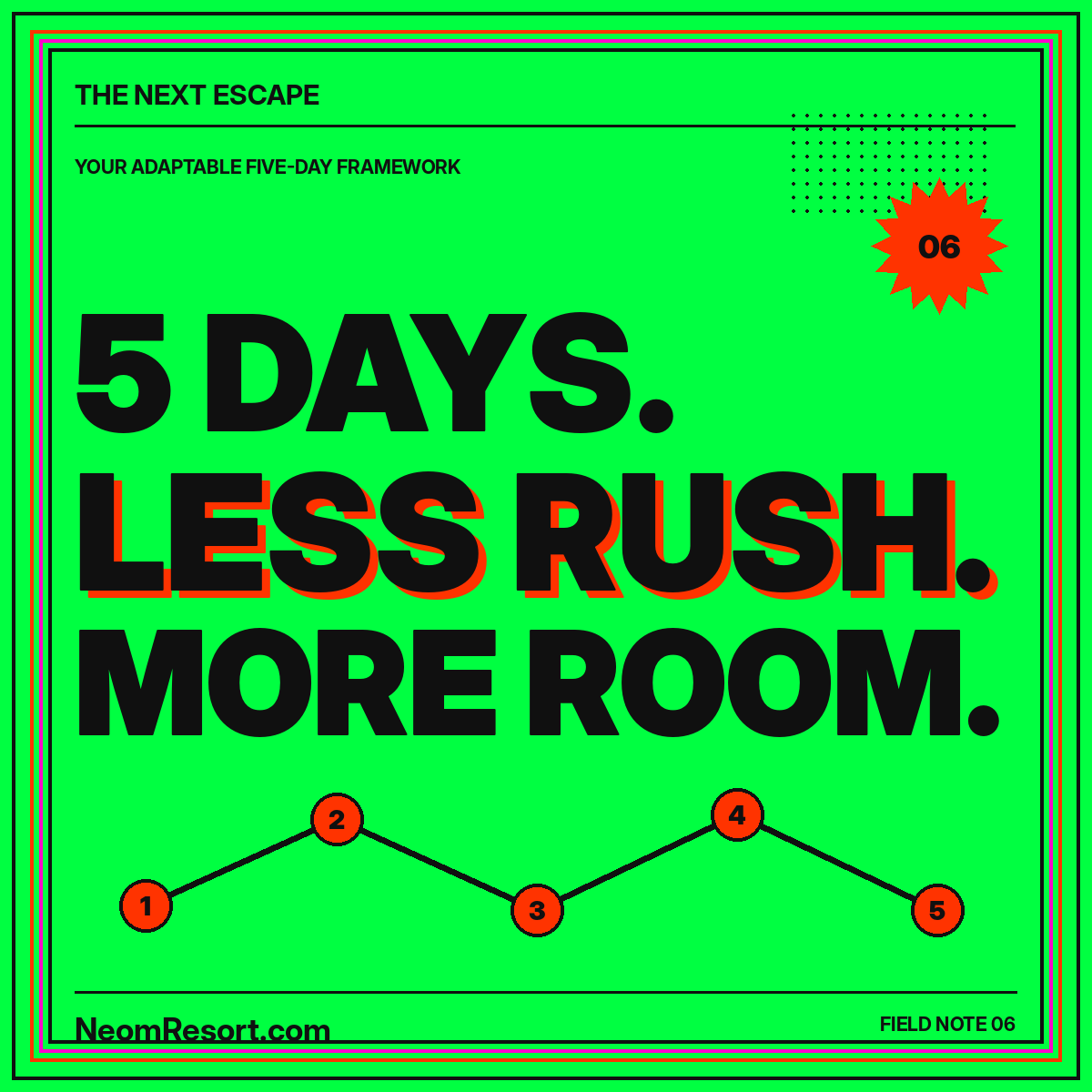
A five-day resort break can feel generous or strangely rushed, depending on how it is arranged. The difference is often not the number of activities but the number of transitions. Packing, waiting, changing transport, and checking into a new room all use time that does not appear in a highlights reel.
This is an adaptable five-day framework for researching a NEOM-inspired or northwestern Saudi Arabia holiday. It is not an operating tour, a guaranteed route, or a suggestion that any named development is publicly accessible. Start with one confirmed accommodation base, then substitute activities and transfers that legitimate providers can verify for your dates and group.
Build the itinerary around a confirmed base
Visit Saudi’s Tabuk destination page is an official starting point for regional exploration. Use regional material to identify interests, then check the actual location, access, and provider for each proposed experience. A regional inspiration page is not a transport schedule or permission to enter a particular site.
Before assigning days, write down your arrival and departure details, the confirmed accommodation, and the essentials for each traveler. Mark anything unconfirmed with a clear note. The itinerary should not look more certain than the information supporting it.
Choose one main base unless a second stop adds enough value to justify the move. For a short break, continuity can be a feature: less packing, fewer coordination points, and more freedom to change the day’s pace.
Day one: arrive without a second deadline
Make arrival the main task. Confirm where you will meet the transfer provider, how delays are handled, and when the room will be available. Keep the first meal simple rather than arranging a time-sensitive celebration immediately after a journey you do not fully control.
Once settled, use a short orientation to understand the property. Find the route to dining, the place to ask practical questions, and the spaces you are likely to use the next morning. Check any essential arrangements that were agreed in advance, such as the sleeping layout or accessibility details.
Leave the evening mostly open. A quiet first night is not wasted time; it gives the group a chance to arrive properly. Save the most important experience for a day when you are not also depending on the flight, transfer, and room handover all running exactly to plan.
Your decision before bedtime
Choose tomorrow’s one priority and confirm its meeting details. Avoid finalizing a chain of minor activities that could make the day unnecessarily rigid.
Day two: experience the setting at its own pace
Use the first full day to enjoy the reason you chose the setting. Depending on confirmed access, that might mean time near the water, a guided landscape experience, or a relaxed day around the accommodation. The activity should fit the people on the trip rather than a generic list of must-do experiences.
Schedule one main block and leave space around it. A morning outing can be followed by lunch and unscheduled time. An afternoon experience can leave room for a slow breakfast. The point is to make the day feel complete without turning it into a sequence of appointments.
Agree how the group will reconnect if people choose different activities. A shared meal or clearly identified meeting place can provide structure without requiring everyone to do the same thing. Confirm communication and pickup arrangements rather than assuming they will be obvious on arrival.
Day three: add one distinctive experience
This is a sensible place for the experience that requires the most advance organization. It might be a guided excursion, a specialist activity, or a meal that matters to the group. Only include it after the provider has confirmed suitability, access, timing, and what is supplied.
Ask what would cause the plan to change and what the alternative would be. Then decide whether the day still works without the headline activity. A good alternative should suit your interests, not simply occupy time because something has been canceled.
Avoid using this day to visit several places whose connections have not been checked. A route can look compact in an image while involving complicated handovers. One well-organized experience often gives a short holiday more character than several loosely connected stops.
Keep the evening proportionate
After a demanding outing, plan an easy evening. After a quiet day, a longer meal may be welcome. Let the day’s actual energy determine the pace.
Day four: protect a day with fewer commitments
By the fourth day, you will know which parts of the stay you enjoy most. Leave enough flexibility to repeat one of them. That might mean a favorite breakfast spot, more time in a shared space, or an optional activity that was not essential to the original plan.
Use this day to accommodate differences within the group. Someone may want another outing while somebody else wants to read. Ask providers about independent participation and any separate arrangements needed. Do not assume that an excursion booked for the whole group can automatically be divided.
Confirm the departure plan before the final evening. Check the pickup time, meeting point, luggage process, and relevant contact details. Resolving these questions now helps the last morning remain a departure rather than an emergency planning session.
Day five: leave room for a calm departure
Work backward from the confirmed onward journey. Include the transfer provider’s advised timing, checkout, packing, and breakfast where appropriate. Do not build the final morning around an activity that depends on returning at the last possible moment.
Keep essentials and travel documents accessible during packing. Confirm how any outstanding property charges will be reviewed and whether the checkout process affects the pickup schedule. These are ordinary coordination details, but they are easier to handle before everyone is standing with luggage.
A final day does not need a new attraction to count as part of the holiday. A calm breakfast and a well-organized departure can be a better ending than one more rushed stop. The goal is to finish the trip with the same clarity that supported its beginning.
Adapt the framework to your travel group
For a couple, protect time that does not need to be negotiated: a shared meal, an open afternoon, or a quiet start. For a family, make the sleeping arrangements and meal rhythm central to the plan rather than squeezing them around excursions.
For a multigenerational group, allow different levels of activity without splitting every day into separate holidays. Choose one shared anchor and make the rest modular. For travelers with accessibility requirements, verify the whole route for each proposed activity, including transport and facilities, rather than checking only the accommodation.
Our before-you-book questions help turn these preferences into provider inquiries. A framework becomes useful when it reflects actual people, not when it contains the greatest number of place names.
Make the costs follow the itinerary
List the confirmed components in the order they occur: arrival transfer, accommodation, meals, essential activities, and departure transfer. Add optional experiences separately. This makes it easier to notice a missing transfer or a meal assumption that the room quote does not support.
Use the resort budget worksheet approach to compare complete versions of the trip. Do not fill gaps with guessed prices simply to make a total look finished. An unresolved cost belongs in the questions list.
The strength of this five-day plan is its flexibility. It creates space for arrival, one distinctive experience, a slower day, and an orderly departure. Replace its open blocks with confirmed arrangements, and leave the rest of the destination’s possibilities for a future visit.